The last four months have been rewarding. On the heels of a great meeting of the board of Educational Credential Evaluators, I scooted to Bengaluru for a meeting of the International Advisory Council of the Centre for Open Societal Systems – COSS hosted by the International Institute of Information Technology Bangalore.
The mission of COSS is to promote the adoption of Digital Public Goods (DPGs) and Digital Public Infrastructure (DPI) at scale to improve the lives of one billion people globally by 2030. This includes the use of Artificial Intelligence in the public interest and commitment to open source approaches. One of the COSS projects I am also involved with is on DPI and DPG with respect to food security. This recently led to my involvement in a new initiative of Aspen Digital – a program of the Aspen Institute – on artificial intelligence and food security with an international team.
En revenant de l’Inde, j’ai commenté la nouvelle stratégie de sécurité alimentaire du Gouvernement du Canada à Radio-Canada pour l’émission “Le Matin du Nord” animé par Éric Robitaille. Mon argument principal fut que c’est plutôt une stratégie de chaine d’approvisionnement alimentaire. Quoiqu’il y a des bonnes choses dans cette stratégie par rapport à la transformation du système alimentaire, il faudrait rajouter une approche de protection sociale pour addresser l’insécurité alimentaire au Canada. Voici l’hyperlien à l’enrégistrement pour ceux et celles qui aimeraient écouter.
June was troubling in some respects. On Monday, June 22nd, I was in Montréal at McGill when my son – a first responder – suddenly called. “Maman, ne vas pas à Côte-des-Neiges!” il m’a dit. Les événements de cette semaine ont été tragiques, en plus des nouvelles de l’Ontario deux semaines avant avec le décès de deux premiers répondants. On top of this, violence in conflicts all over the world with people losing their lives, loved-ones, homes, land and livelihoods. And a reminder that armed conflict is the number one cause of food insecurity.
What is at the root of this aggression? Are those who perpetrate violence victims of childhood abuse or neglect who didn’t get the support and healing they needed? Furthermore, how do some of these individuals with “dark triad” personality issues end up in powerful leadership positions? Why do we dehumanize each other to begin with? Je veux comprendre le pourquoi. Est-ce c’est la nature humaine? We need more ethical, courageous and human-centred leadership. This is what prompted me to make this video.
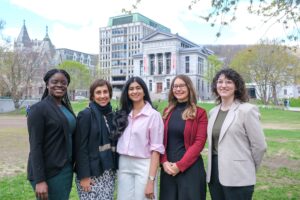
The highlight of early July was the mind-blowing policy lab presentations by the brilliant Max Bell School of Public Policy students. This signals the end of the 11-month intensive program for the 2025-26 cohort. I’m particularly proud of the group I coached pictured at the top of this post who did their capstone project on water security further to a policy challenge issued by the Metcalf Foundation. Below is a picture of some of the policy lab coaches at our farewell celebration.